Vyre / Architecture / Agents
Agents, one of the four pillars.
Agents: named teammates that wake on a task.
An agent is a named, persistent helper with its own instructions, memory, context and access. People chat with it, assign it tasks and use it in Flows. It finishes a task, hands it on, or says it is stuck.
A task arrives. The agent finishes it or says why it cannot.
When a ready task has an agent as its doer, Vyre wakes the agent with that task, its record and the Flow it came from. It is never left open in silence.
- One job thread for each taskA claim in its own table stops a restart from starting a second one. The thread id is written on the task.
- The agent starts and submitsThe wake never marks the task done. The agent does, and the kernel checks the output.
- Stuck has a reasonIf the agent cannot start, or ends with the task still open, the task is marked stuck with a plain reason and a suggested fix. Secret-looking strings are cut from the reason.
Animation: a task wakes an agent
What an agent has.
A folder, a memory, and a list of what it may use.
An agent is a folder with its instructions, a memory of what it learned, its own context files and the Vault items its person gave it.
Instructions
AGENTS.md, with a CLAUDE.md beside it that points at it, written fresh at every launch. Each edit is a version and applies from the next turn.
Memory
Each row is a Fact, a Note, a Decision or a Lesson, with its source. A lesson has a button, Make it an instruction, and then it sits in AGENTS.md.
Context
Uploaded files and linked folders the agent reads when it works.
Vault items
A list of items the agent may use without seeing the value.
Sharing
Share an agent as Can use or Can edit, the same two words the Vault and Flows use. Only the creator, an owner or an admin shares.
Project reach
An agent has a list of projects, or all. Work outside that list fails with a plain denial that says the person must give it that project first.
What my assistant may do
A person turns areas and tools off for their own assistant, so its reach is set by the person, in one screen.
Teammates and duties
A project can hold one agent per role, each with its own notes. A duty runs on an event or a schedule, and a duty an agent proposes for itself stays off until a person turns it on.
How the wake works.
The kernel log wakes it. The task bounds it.
A watcher subscribes to the kernel’s log. It acts on a task that was created, made ready or unblocked.
- 1A task eventtask.created, task.readied or task.unblocked appears in the log.
- 2The checkThe task is ready, its doer is an agent, it was not made by hand, it is not a follower’s note, and it is under a day old.
- 3One use lentThe agent is lent use of that one task, and nothing else.
- 4One job threadThe agent’s own session starts with the task, its record and where it came from.
- 5It endsDone, handed on, or stuck. The lent use is taken back when the task completes, is approved, rejected, skipped or voided.
- The chain is the person, then the agent.Its authority is the intersection of their grants, so an agent never has more than the person who started it.
- Wake tools are closed to models.The calls that wake, record or fail a job are marked for modules only, so no model can call them.
- An agent cannot read another agent.Files, context, sharing and the vault list of an agent refuse an agent, model or MCP caller.
- Held acts go through the Gate.A send or a payment from an agent is requested and a person approves it.
In the app.
The Agents screen, with sample data.
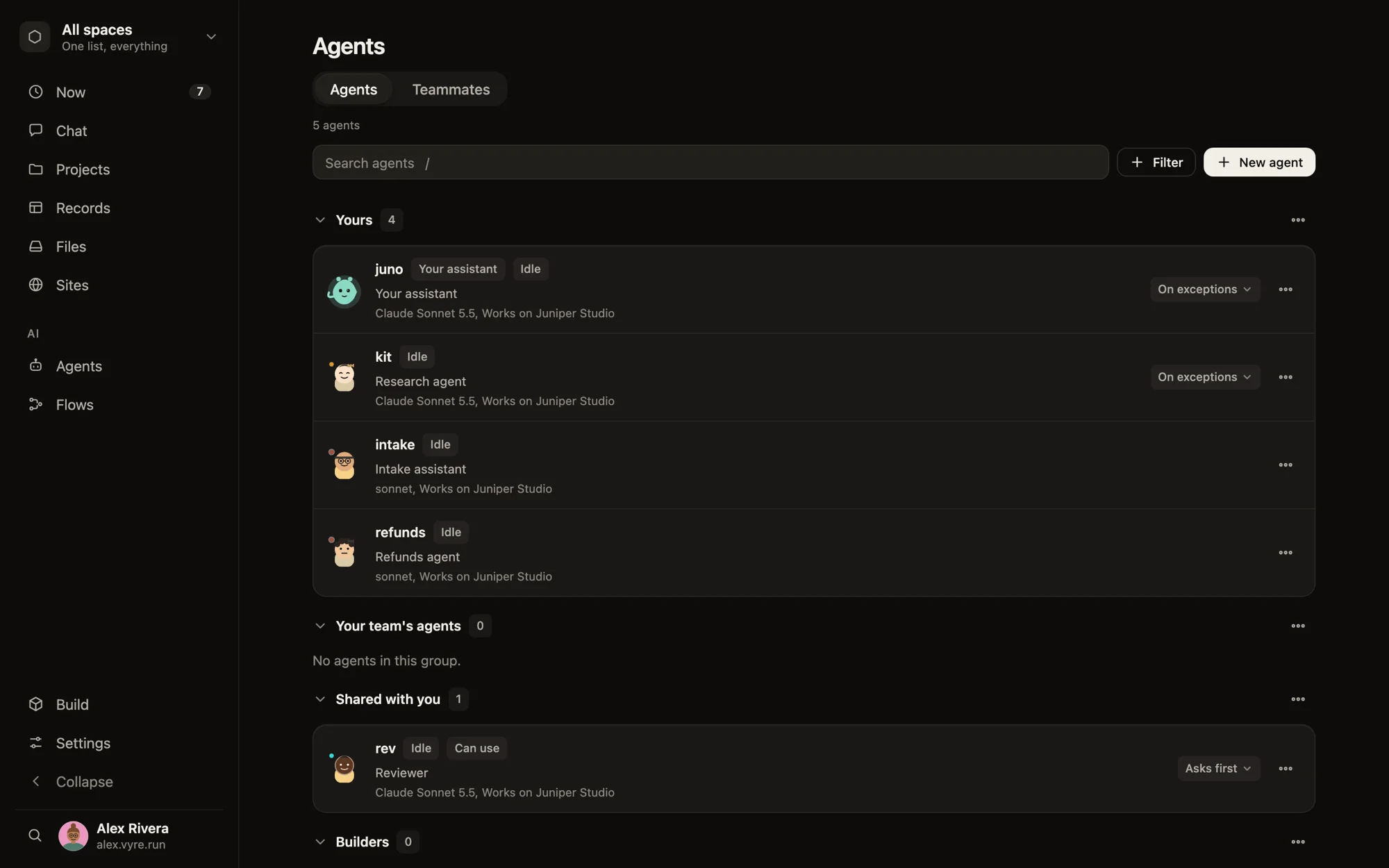
An agent can make agents, within its own reach.
- Open to agents
agents.list,agents.create,agents.update,agents.askandagents.rollover, each bounded by the caller’s grants. - Short-lived helpers
agents.spawnstarts a helper that works as you, with your access or less. - Outside AI toolsAn AI a person connects over MCP comes in through the same door, as that person and within its key’s reach. Sends still wait at the Gate.
- AGENTS.md
- Its instructions, versioned
- CLAUDE.md
- A pointer, written at each launch
- Memory
- Facts, notes, decisions, lessons
- Context
- Files and linked folders
Coming next
- 0.5.1: a due time and a failure path on agent steps, so a Flow can route around an agent that has not answered.
- 0.5.1: credentials lent to a woken agent for one job, use only.
Direction, not a shipped feature. Dates and scope live on the direction page.
Bring your own software stack, or build a module.
Vyre can be extended by integrating your Zoho, QuickBooks, RingCentral and the rest of your software stack*. Today, a custom module adds what the built-in agents lack, and a Flow step or a Vault connection reaches the outside system.
*where the vendor provides an API
- Coming in 0.5.2
- Integrations, packaged as modules, for the software a firm already runs.
- Today
- A connection in the Vault plus a Flow web step, or a custom module. It passes through the same grants and checks as any other.
- Over MCP
- An AI agent connected over Vyre’s MCP can help set this up. It acts as the person who connected it, within its key’s reach, and the Gate still holds anything that leaves.
Connects to.
How it fits with the rest of Vyre.
Code paths: core/agents/index.js · core/daemon/agent-wake.js · core/agents/config.js · kernel/tasks/tasks.js